Your Startup Is Already On 1 of These 6 Paths

.png)

.png)
In the early days, every startup’s growth chart looks the same - everyone starts from zero. Then, a jittery, flat line crawling along the bottom of the screen. Investors squint for signals and founders tell themselves a story.
Everyone hopes they are building the Queen.
Thanks for reading! Share with a founder who should read this and subscribe to get the next article in your inbox.
Here is the harder truth. Most startups do not become what they imagine and by year three, the underlying physics of your business are already pushing you into one of a small number of paths. The outcome feels like destiny only in hindsight.
There are six structurally distinct paths.These are economic and operational trajectories, and by year three, you can usually get a sense of where you may land, yet some will defy gravity.
Listen to this episode HERE
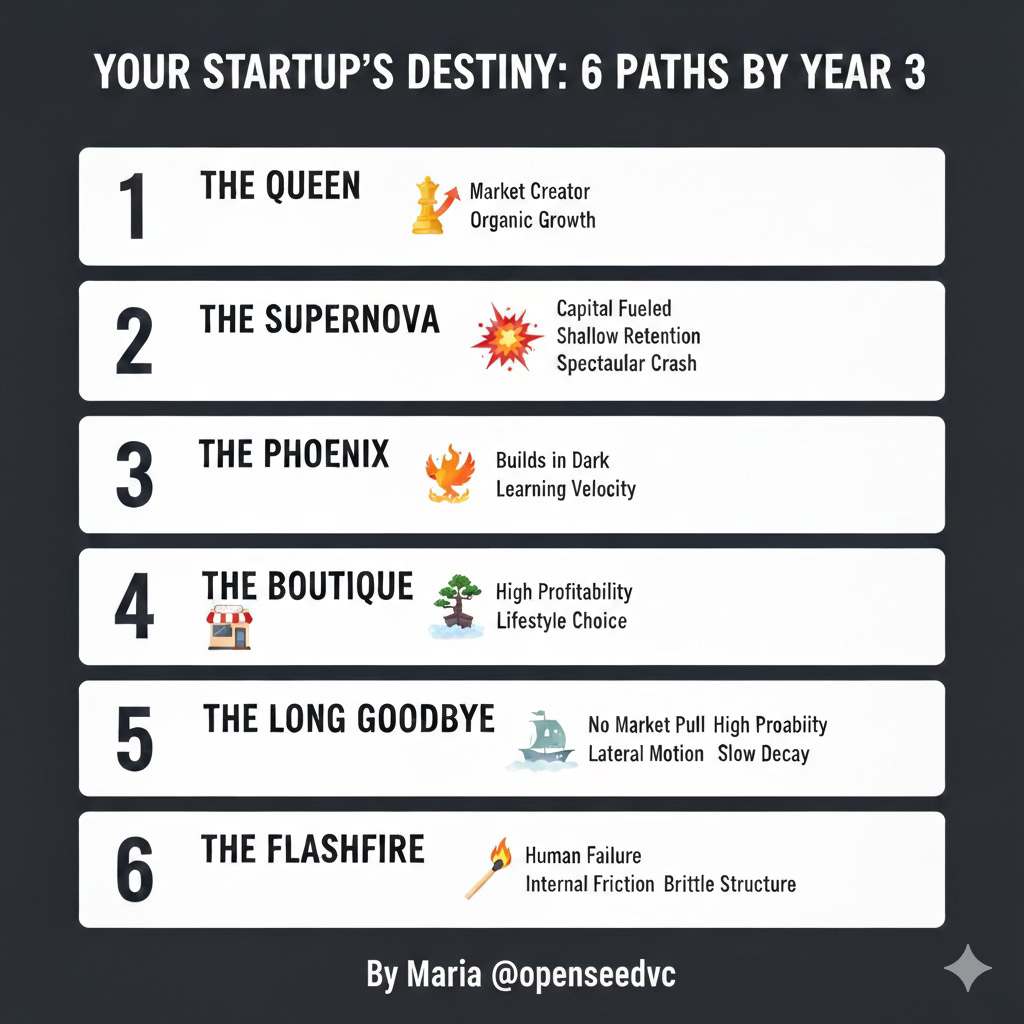
1. The Queen
This is what venture dreams are made of. These companies find a real complex vein of truth and build around it before the world fully sees it. They anticipate new markets, build moats early, and many have in-baked network effects that make it hard for others to compete later. They do not just grow. They get pulled by the market that they optimised for.
Core mechanics
• Organic demand leads to paid demand. Lower than market CAC by design.
• Retention is high and stable early. High value creation and strong user engagement.
• Gross margins improve with scale. Insane operational efficiency. High margins.
• Culture and execution compound instead of fragment. Strong brand appeal. Cohesive talent.
Leading indicators by Year 2 - 3
• Strong 12 month cohort retention, increasing ACVs & LTVs (Life Time Value)
• Net revenue expansion without heavy discounting
• CAC flat or falling while revenue grows, healthy margins with line of sight to more efficiency
Examples
WhatsApp scaling to hundreds of millions of users with minimal headcount. Stripe turned a simple developer wedge into infrastructure for the internet.
These companies look inevitable only in retrospect because the fundamentals were aligned early. They were right, early, and built fast enough to matter.
2. The Supernova
Looks like a Queen. Smells like a Queen. Is not a Queen.
These companies grow fast but are being carried by capital or temporary tailwinds. They are pushed more by spend, pulled rarely by product. It’s not always an either or, but a balance of both but with a skew to being pushed by capital. They may show early market interest, but it does not translate into durable value creation.
Core mechanics
• Growth is mostly bought, not earned
• Unit economics gaps never close
• Valuation runs ahead of operational reality
Leading indicators by Year 2 to 3
• LTV to CAC does not improve with scale
• Retention is shallow beneath the top line
• Contribution margin is negative without subsidies
Examples
WeWork. Bird. Quibi. Fast.
Queens are often paranoid they might be Supernovas and build deep moats and diversified value creation. Supernovas are confident they are Queens and build like so. The divergence happens silently in the numbers, not the headlines. The eventual death is a lagging indicator.
3. The Phoenix
The Phoenix does not break out early. It spends years building product depth, technical leverage, or infrastructure before the market is ready. Many look like they are dying right before they turn. The nuance here is, Phoenix’s often have high conviction backers with deep pockets and patience to buy them the time needed to create them without conventional commercial metrics.
Core mechanics
• Building optionality before demand
• Long feedback loops optimized for real customer love
• Product depth precedes market readiness
Leading indicators by Year 2 to 3
• Small user base with extremely high engagement
• Strong technical or network foundation without revenue yet
• Clear learning velocity even without growth
Examples
Airbnb before the photography pivot. Slack out of Tiny Speck. NVIDIA built CUDA long before AI hype.
Phoenix companies learn fast before they grow fast.
4. The Boutique
These companies work, but they just do not scale to venture outcomes.
They hit a plateau of comfort and stay there by design or by constraint. Founders often prioritize autonomy, profitability, and control over hypergrowth. A $25m ARR company might be great for founders, it isn’t the dream for most VCs.
Core mechanics
• Profitable, small, controlled
• Founders choose freedom over scale
• Growth is optional, not mandatory
Leading indicators by Year 2 to 3
• Steady revenue without aggressive reinvestment
• Clear growth ceiling regardless of growth hacks
• Founder control preserved
• Limited appetite for dilution or blitzscaling
Examples
Basecamp. Gumroad post pivot.
Not a failure to founders, but usually a write off to VCs.
5. The Long Goodbye
These companies never find real market pull. They survive on narrative, or bridge rounds until time, energy, and capital run out. They stick with it though, people may leave the team, they may cut staff, they keep going till they eventually read the writing on the wall, and call it either because they run out of energy, time and often money.
Core mechanics
• No true product market fit even after several pivots or iterations
• Lateral motion instead of forward motion, very little growth
• Internal complexity rises while external demand stagnates
Leading indicators by Year 2 to 3
• Product changes do not improve retention
• Sales effort rises without better conversion
• Strategy shifts every 6 to 9 months
• Founder energy visibly erodes
Examples
Jawbone. Evernote. Many well funded startups you never hear about again. These companies stay busy but do not move forward.
6. The Flashfire
A short, sharp burst that goes out before the wood catches.Usually built on a perfect paper story but dies from human system failure, not market physics.
Core mechanics
• Team incentives and motivations misaligned
• Founder resilience breaks early
• Organizational fragility under pressure
Leading indicators by Year 1 to 2
• Co founder tension appears early
• Decision making slows dramatically after seed
• Key team members disengage or leave
• Founders avoid hard conversations
• Execution feels heavy and joyless
Flashfires collapse socially before they collapse economically.
Why the future is hard to predict
Hindsight is 20/20 because, in Year 1, every path looks identical. Everyone starts from zero. The Queen and the Supernova both show high growth; but there’s a split, the Queen dominates and the Supernova flames out. The Phoenix and the Long Goodbye both look like they are stalling. Again, splits start to happen.
The difference isn’t found in visible metrics like top-line growth. It’s hidden in invisible behaviours that define retention, margins, and learning velocity. You can never know the future for certain, but if you look at the underlying physics by Year three, you can see it much earlier than most admit.
- Queens grow, learn and build lasting advantage in the right market.
- Supernovas scale fast, but fail to learn fast enough to sustain/secure it.
- Phoenixes aggressively learn and live long enough to emerge transformed.
- Long Goodbyes don’t learn quickly enough to grow quickly enough
- Flashfires break at the fundamental level from missed massive blindspots
You never know for sure because in all of this, there’s the unknown called luck.
Market shifts, regulation, capital markets, and more. However, you can increase your chances of luck by knowing what the “unlucky” ones didn’t do.
May the odds ever be in your favour.
Till next time.
Maria @ Openseed VC
Thanks for reading! Subscribe to get the next article straight into your inbox.
Starter funding as you build your
tech startup?
Looking for smart first funding for a strong headstart?
If you’re looking to get in touch about PR, sponsorship, investor relations, you can find us at:
contact@openseedvc.com

Openseed Ventures is an authorised representative of Palace Ventures Limited which is authorised and regulated by the FCA
Openseed Fund I LP is a Fund Licensed and Regulated by the Financial Services Commission