Why "Traction" Can Hurt Your First Round

.png)

.png)
As a founder starting on day zero it’s smart to optimise for revenue, pilots, something that proves that there’s market appetite for what you’re building. The good news: you may get the revenue. Maybe it’s modest, but it’s something. It’s some evidence that the market wants what you are building enough to pay for it, even in its early scrappy stages. That’s a good thing.
But, now you go to fundraise for their first round super pumped and you might be tempted to anchor your narrative on this ARR number, and for some reason investors aren’t converting. You are left wondering.
Where did i go wrong?
We have a strong product, we even have customers who are actually paying on day zero.
Surely this is impressive?
The bad news: this is a fundraising zone very few founders talk about, and a lot of founders are stuck in. It’s not uncommon, it’s just not spoken about as often, and as such, more founders make the mistake without realising how common it is.
I call it the 50k ARR trap.

A quick note before we go further. The €50k number isn’t prescriptive, it’s just a directional steer for the lukewarm middle. Later, I’ll show you a founder at almost ten times that number sitting in exactly the same place.
So, here’s the trap in one line:
It sits between zero revenue and the kind of traction that makes a pre-seed round obvious. It’s neither, so early stage investors find it harder to build conviction.
At €50k ARR, the product works, people are paying you. But it isn’t enough to make the growth story compelling, and the investors you’re pitching are comparing you with companies who are playing a completely different game, and as a result, they look much better compared.
The middle is disappearing
The data backs this up. Atomico’s State of European Tech shows the number of smaller early-stage rounds in Europe has fallen by roughly 20% per year since 2022, driven primarily by a decline in sub-$1m rounds, and the classic pre-seed funds still doing the earliest cheques are writing fewer, larger ones.
At the same time, capital is concentrating at the top: in 2025, seed rounds made up 14.2% of European tech deals but just 3.3% of the capital raised (Tech.eu), and $1m–$3m pre-seed rounds are more popular, up from $500k–$750k two years ago (Concept Ventures).
The market is becoming a barbell: unusually large conviction cheques on one end, a shrinking pool of angel style checks on the other.
The middle, where €50k ARR lives, is thinning out.
Two founders, same trap
I’ve watched many founders face this. I’ll give two examples.
Founder one had raised a modest angel round: six pilots in progress, €50k ARR on the horizon, a credible team. But when we mapped the landscape, the classic pre-seed and seed funds writing massive first cheques weren’t just looking for proof the product works. They were looking for an outlier team with an insane right to win, an undeniable market creation opportunity, a plausible path to steep revenue velocity, and some early signals of a repeatable way to reach that market, informed by experience or evidence.
€50k ARR alone simply doesn’t tell that story.
The deeper risk was that chasing conventional traction had crowded out the learning, of problem validation and a repeatable GTM framework that could carry a VC-legible narrative about plausible market domination. They are not mutually exclusive, but an obsession with pure revenue can cause you to miss the point of the stage you’re at. A right to the problem, a compelling and superior GTM strategy. The idea is for investors to infer that your revenue size and velocity is inevitable.
€50k ARR alone doesn’t signal a true market pulse, nor is it a convincing predictor.
What you need at that stage is a top-tier team with founder problem fit, a solid market-driven narrative for revenue velocity, and some evidence that it’s plausible. Revenue works here. But current revenue numbers on day zero as the primary narrative is often just not compelling enough, and even when they are, it’s impossible to tell if they’re enduring.
A €50k ARR single-narrative pitch confirms that early customers will use your solution. It also confirms that people will pay. But an ambitious VC hunting for market outliers is likely to have a lukewarm reaction and probably pass on the opportunity if that number is the vein of your pitch.
Come back at €500k ARR six months later and you’re fighting the memory of the first conversation, now there’s even more questions around velocity, and confirmation bias kicks in.
Founder two: came from the opposite side: €500k ARR, a really small team, six months from sales day zero. A couple of enterprise contracts. Multi-million pipeline. Genuinely impressive. Yet the feedback was consistently “we love it, but we’d like to wait and see.”
What was the reason?
One was, they were building in an industry that was so new there were no patterns to match, so the traction bar simply moved higher, to a number no one really knows. Larger funds want evidence, but they also want a plausible inevitability, as much as you can get on day zero.
The revenue wasn’t the problem. The growth and venture outlier narrative hadn’t crystallised enough to get conviction investors on board, and traction-based investors couldn’t place it on a market map they recognised.
It was also the dying middle.
The “dying middle”
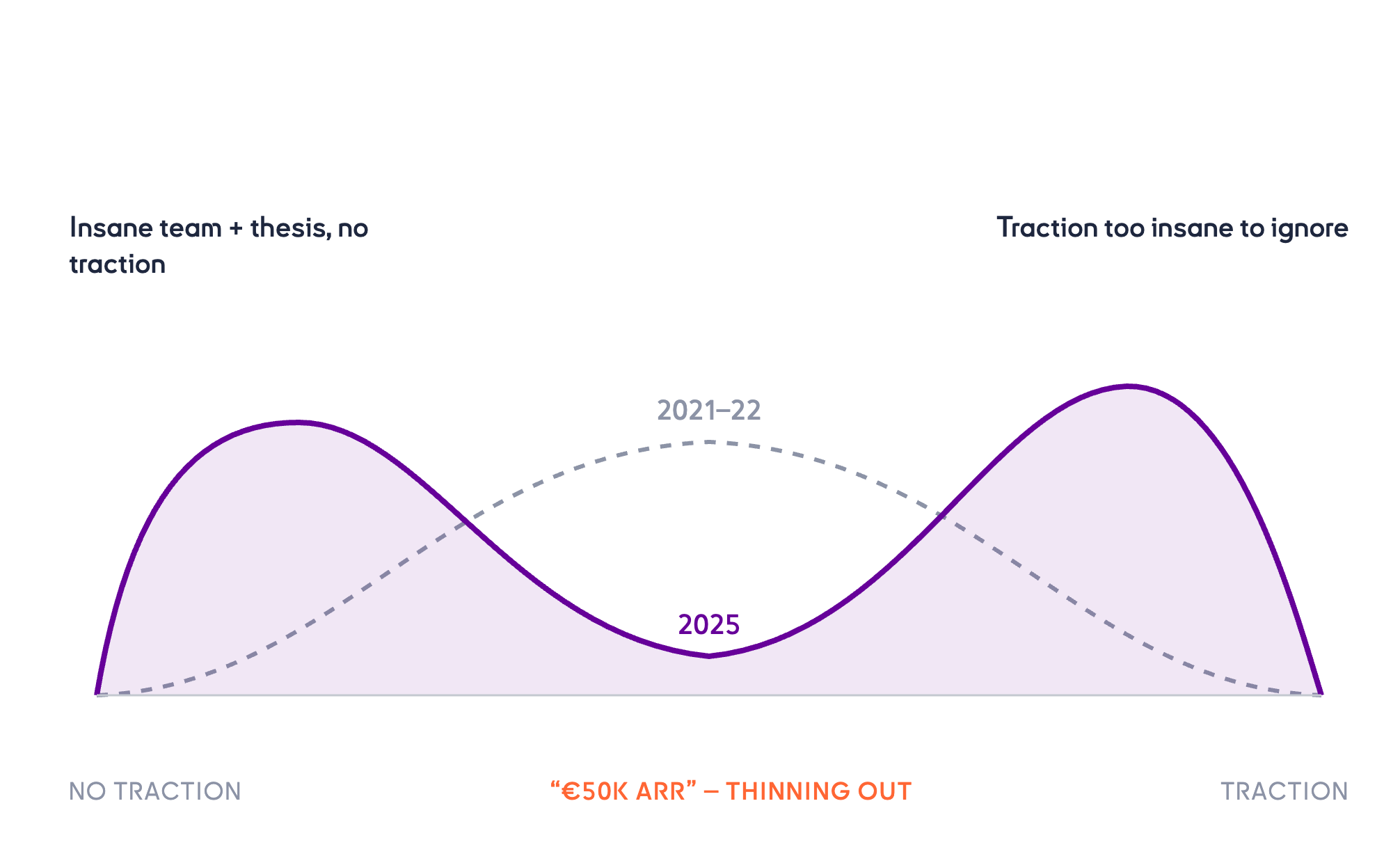
To the left of the dying middle, you’re a conviction bet. The investor backs the founder and thesis, very often at zero or low revenue. It’s not about revenue on day zero. This is reserved for founders with rare, directionally correct, market-aligned expertise and the pull to attract brand-name capital and talent.
To the right, you’re a traction bet, but the bar keeps moving and the numbers need to be impossible to ignore and high in quality. The team “quality” also needs to stack up.
In the middle you’re neither. You’re asking investors to believe in a trajectory the data doesn’t yet confirm with confidence. Some investors may, many won’t. Except you’re one of those rare founders (logos, unique expertise, networks and all, it’s simply the reality of things).
Traction has a silent superlative: velocity
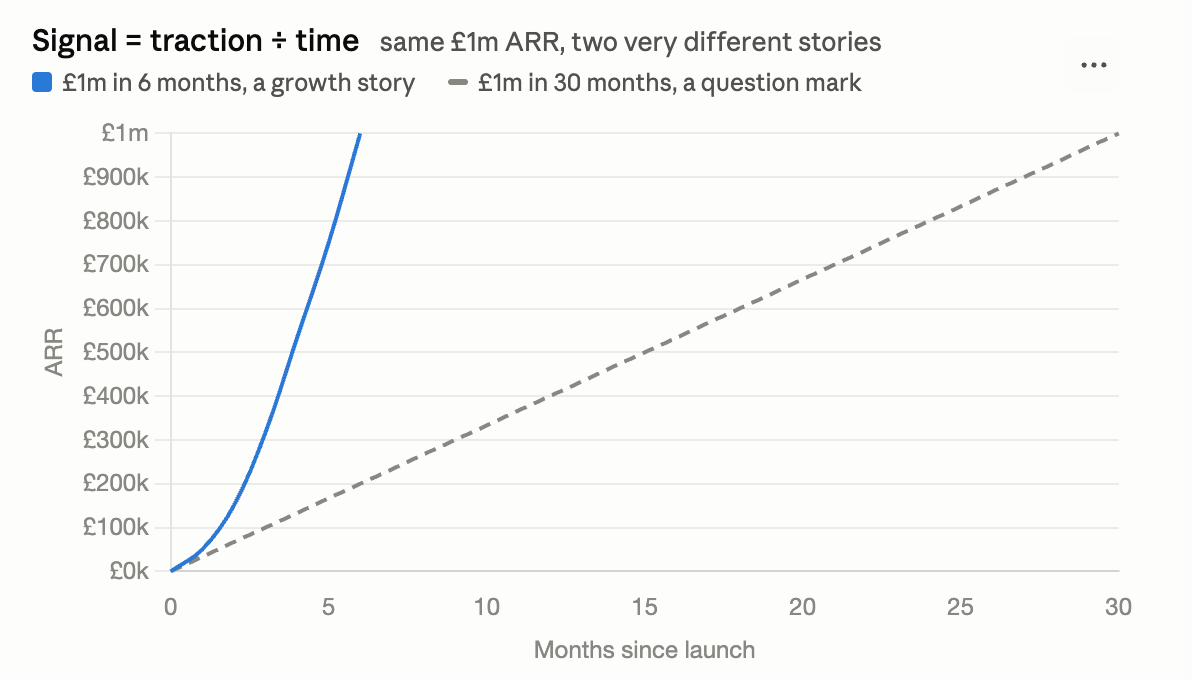
Know, too, that there’s a hidden variable sitting on every traction number: duration.
Signal = Traction ÷ Time.
The same €1m ARR reached in 3 months is a rocket; reached in 30 months, it’s a question mark. Investors fund velocity, not just traction or revenue, which is why speed of learning in the right direction matters at the day zero stage.
What “traction” actually unlocks the seed round
It isn’t always revenue. It’s often what I call signals of plausible inevitability, and in my experience a handful of them tend to carry more weight than the revenue line does.
The first thing to know is every early stage investor anchors on the team.
And what makes a good team is often a combination of some “track record”, rarity and match of expertise and networks to the business at hand. But that often gets you quickly past the first call.
On deeper look, its about the early signals on market and early signals of user behaviour if any. Daily active use and session depth, because how often they come back and how long they stay can say more than how many signed up. Admin hours displaced, ideally with some sense of what the hour is worth. Value saved or created per customer per month, in money rather than adjectives.
Qualified pipeline, by which I mean named accounts with a stage and a value attached to them. A healthy ACV that could scale to a multi million business in years (now months), and of course, a repeatable GTM motion, which often just means the same thing worked twice, in the same way, for the same reason that can be turned into a sales process that delivers at scale.
These dots become lines, and they tell a story about a solution that has created so much value in someone’s workflow that monetisation is inevitable. That story is more fundable, even before the revenue line, than a traction number that’s impressive but isn’t really telling a story.
So, friends, there’s no magic number. Your traction number reads differently depending on your team’s perceived quality, your market direction, timing, investor perception, and good old luck. It’s all so vague, and it’s a feature not a bug, the opacity is the risk that is the other side of the potential returns.
My initial suggestion at day zero is to hold off on going officially to market to traditional pre-seed investors until you have an evidence-based thesis/narrative that the value you create has a plausible, somewhat evidenced, path towards being a high growth market outlier. One way I’ve seen founders sense-check this for themselves is to take the revenue number out of the deck entirely and see what’s left of the story.
It isn’t always a straight line. Sometimes the narrative needs iteration from your customer conversations and friendly investor chat feedback loops, and there’s something to be said for doing that iteration before you get to the funds you really want on your cap table so you simply don’t burn your leads.
Investors never forget.
The Openseed Perspective
At Openseed, we sit before the trap exists. On day zero. We invest first cheques in exceptional operators, and our sweet spot is immediately post-incorporation, and we are perfect for the stage where it’s not yet clear, it isn’t yet refined, and you’ve just started. That’s our sweet spot. If that’s you, learn more at www.openseed.vc/faq.
Read the previous article? Your Startup Is On One Of These Six Paths
Till next time,
Maria Rotilu
Starter funding as you build your
tech startup?
Looking for smart first funding for a strong headstart?
If you’re looking to get in touch about PR, sponsorship, investor relations, you can find us at:
contact@openseedvc.com

Openseed Ventures is an authorised representative of Palace Ventures Limited which is authorised and regulated by the FCA
Openseed Fund I LP is a Fund Licensed and Regulated by the Financial Services Commission